 Zumba
Early access
NATIVE RUST · GPU-RENDERED · macOS
The code editor that works with your agents.
Claude Code, Codex, OpenCode or any OpenAI-compatible model work in their own copy of your project. Every turn is checkpointed, every line remembers the prompt that wrote it, and you always see what it cost.
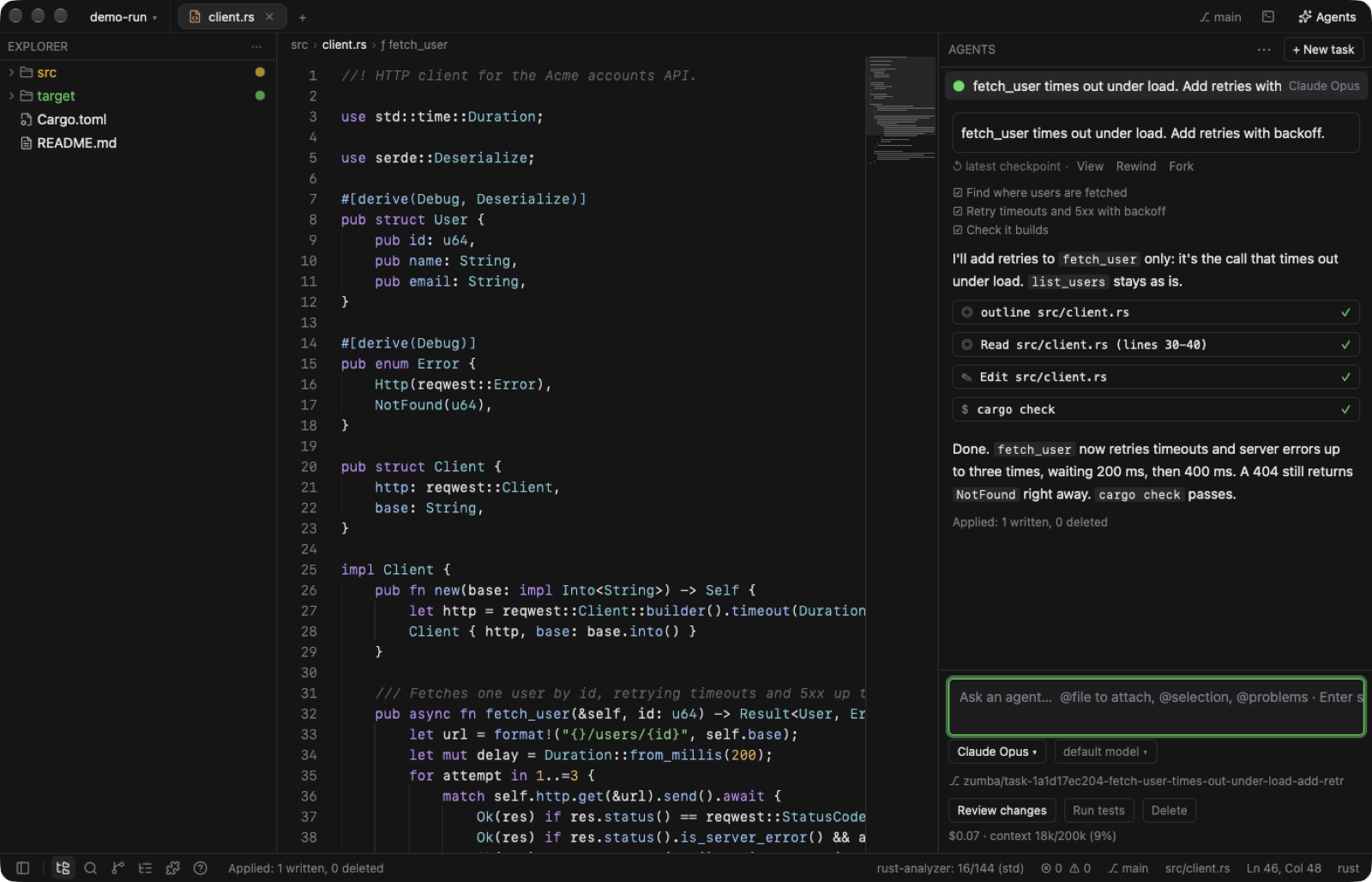
01 / AGENTS
Talk to it like a chat. It works like a colleague.
Ask for anything, from a question to a refactor. The agent works in its own git worktree, so it never trips over your unsaved edits. When its turn ends, the changes land in your files through a three-way merge that keeps whatever you typed meanwhile.
- Undo last turn takes the agent's changes back out of your files.
- Rewind or fork from any earlier turn.
- Review by file or hunk when you'd rather apply by hand.
02 / RACE & TEAM
One prompt, several agents. Keep the best.
Race gives the same task to Claude Code and Codex side by side, then lets you take the winner, or mix them file by file. Team has a lead agent split a bigger goal into parts that several agents build at once, each knowing what its teammates own.
Compare → take lib.rs from Claude Code, extra.rs from Codex
03 / PROVENANCE
“Why is this here?” has an answer.
Lines you apply from an agent remember which agent wrote them and for which prompt. Put the cursor on one and the end of the line tells you; click it to open the conversation at that moment. Lines no agent touched show git blame instead.
04 / TOKENS
Spend fewer tokens, and always see the bill.
- Lean rules keep agents terse: search before reading, read only the lines they need, keep command output short.
- Editor tools over MCP: agents ask Zumba for a file's outline, where a symbol is defined, its references and your diagnostics instead of reading whole files.
- Handoff: when an agent hits a rate or usage limit, another one picks up in the same worktree with a summary, the plan and a log of why each decision was made.
- Cost on every task: reported by the agent, or estimated from your own prices per model.
05 / ANY MODEL
Bring your own agent, or your own model.
Claude Code, Codex and OpenCode work out of the box with your own sign-in and settings. Add any agent that speaks ACP, or point Zumba at an OpenAI-compatible endpoint (Ollama, LM Studio, OpenRouter, Groq, vLLM) with a few lines of config. Keys stay in your environment.
# ~/.config/zumba/settings.toml
[[agents]]
name     = "Qwen (Ollama)"
base_url = "http://localhost:11434/v1"
model    = "qwen3-coder"

[[agents]]
name    = "Gemini"
command = "gemini"
args    = ["--experimental-acp"]
06 / AN EDITOR FIRST
Fast without agents, quiet when you want it.
Written in Rust on GPUI. Opens big files and keeps typing smooth.
Diagnostics, go to definition, references, rename and format on save.
The shape of the whole file beside the editor; click or drag to jump.
Each command gets a gutter bar colored by how it ended.
Blame, side-by-side diffs, file history and a time-lapse you can export as a GIF.
Markdown, HTML, SVG and Mermaid render as you type; links open in the editor.
Normal, insert and visual, when you want them.
One shortcut hides every agent panel, hint and live edit.
07 / PLUGINS
Plugins that can't surprise you.
Plugins are WebAssembly components with limits on time, memory and work, and only the permissions they ask for: you see the list before installing. Install from a folder or a git URL, or write your own in Rust.
Ships with Smart Paste, HTTP Client, Text Tools, TODO Finder, JWT Decoder, Generators, Bookmarks and Regex Tester.
Zumba is in early access.
It runs on macOS. Want to try it?
Request early access